7 Hours Later: Removing a 4kg Liver Tumour at a KNH Surgical Camp
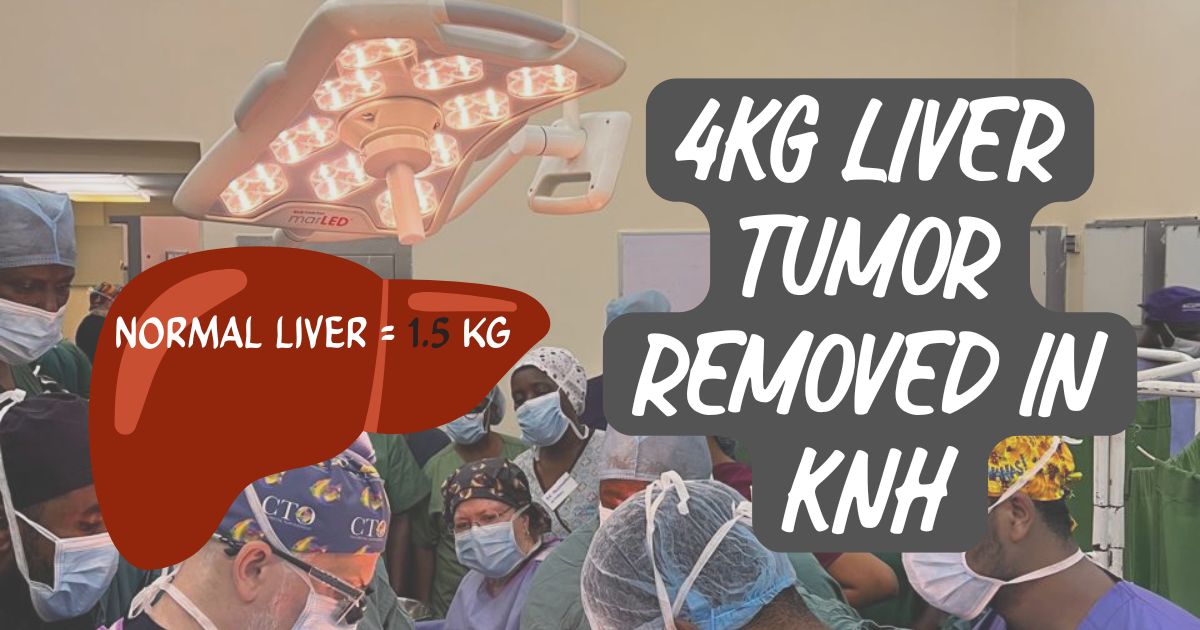

A healthy adult liver weighs about 1.5 kilogrammes. A team at Kenyatta National Hospital spent seven hours removing a tumour that weighed four — close to three times the weight of the organ it had grown in.
The operation was a right hepatectomy — the removal of the entire right lobe. It is among the least forgiving procedures in general surgery. The liver has a dual blood supply and drains through veins sitting directly against the vena cava, so much of the work is about controlling bleeding rather than cutting. Get the plane wrong and what remains loses either its inflow or its drainage.
It was the standout case of KNH's Hepato-Pancreato-Biliary (HPB) Surgical Camp, which ran from 10 to 12 June.
Nobody Does This Alone
An operation that long needs the room properly staffed for all of it. HPB specialists from KNH, the University of Nairobi and other institutions worked the case alongside anaesthetists, theatre nurses and technical staff — and anaesthesia for a seven-hour hepatectomy is a significant undertaking in its own right.
The camp also drew partners from outside the country: the Europe-Africa HPB Association, Aga Khan University, and visiting surgeons from Egypt's University of Science and Technology Hospital.
Thirteen HPB Procedures in Three Days
The hepatectomy was the headline, but not the whole list. Across the three days the camp delivered thirteen specialised HPB procedures — four liver resections, one Whipple's procedure, two hepaticojejunostomies and six laparoscopic cholecystectomies.
That spread is worth reading slowly. A Whipple's removes the head of the pancreas together with the duodenum, part of the bile duct and often part of the stomach, then rebuilds the plumbing three separate ways. A hepaticojejunostomy joins the bile duct directly to small bowel, usually because the original drainage has been lost. At the other end of the range, laparoscopic cholecystectomy is comparatively routine.
Fitting that mix into seventy-two hours means the list was built deliberately — the heaviest cases while the team was fresh and the visiting expertise was in the building, the shorter ones filling the gaps around them.
The Teaching Was the Point
The camp was led by Dr Gibson Musila, Head of the Department of General Surgery at KNH. What the hospital chose to emphasise afterwards was not the size of the tumour but the mentorship and skills transfer the three days made possible.
That is the right emphasis. HPB is a subspecialty that takes years to build and is easy to lose. It rests on a small number of trained surgeons and on the anaesthetists, radiologists and nursing teams around them, and it thrives only where the case volume keeps everyone practised.
A camp that treats a list of patients has helped those patients. A camp that leaves behind people who can do the same operations next month, with no visitors in the room, has changed the hospital.
Complex Care, Closer to Home
For Kenyan patients needing HPB surgery, the options have long been narrow. For many the real answer has been travel — often abroad, always expensive, and out of reach for most families.
A camp does not fix that by itself. What it does is prove the capability exists locally and give the local team the repetitions to hold on to it. That is the substance behind KNH's own framing of the camp: complex specialised care delivered at a national referral centre rather than exported.
Seven hours is a long time to stand at one table.
For the patient on it, it was the difference between a diagnosis to be managed and a problem that could be solved.
Camp details courtesy of Kenyatta National Hospital (@KNH_hospital).